




新闻中心
|
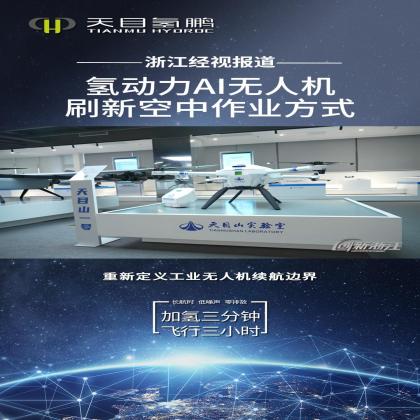
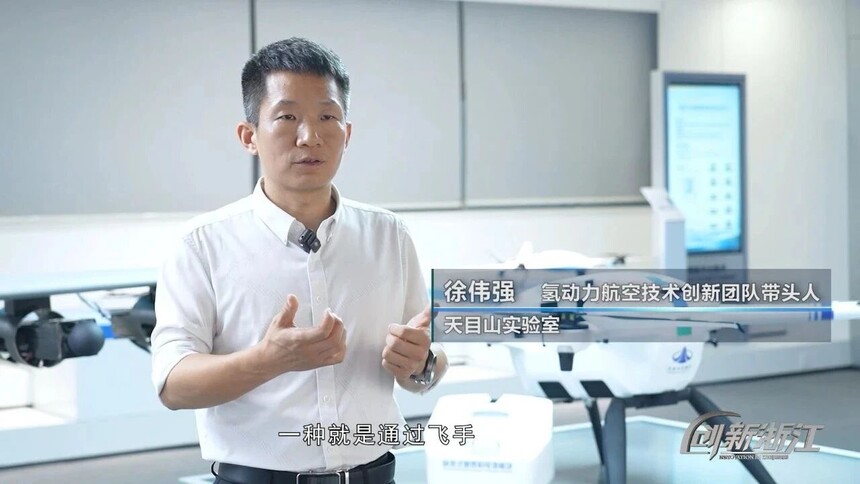
Hydrogen-powered artificial intelligence drones have completely transformed the way they fly in the airIn recent years, Zhejiang has been committed to the strategic goal of fully building a high-level innovative province, focusing on promoting the integrated development of education, science and technology, and talent, as well as the in-depth integration of scientific and technological innovation with industrial innovation. A number of landmark innovative achievements have emerged, providing strong support for achieving high-level self-reliance and self-strengthening in science and technology. In this episode, let's take a look at the Tianmu Mountain Laboratory together and see how the latest research achievement, "Tianmu Mountain No.1 2.0 Version AI Intelligent Hydrogen-powered Long-endurance Unmanned Aerial Vehicle", is reshaping the new landscape of the hydrogen-powered unmanned aerial vehicle industry. Xu Weiqiang, the leader of the hydrogen-powered Aviation Technology Innovation Team at Tianmu Mountain Laboratory: This is a lidar, and this one is a multi-purpose depth camera. The multi-sensor fusion of vision and laser can achieve multi-fusion navigation and obstacle avoidance. This is a quick-release fuel cell module, which can be quickly disassembled and assembled within 5 seconds. In the achievement exhibition hall of Tianmu Mountain Laboratory, Xu Weiqiang, the leader of the Hydrogen-powered Aviation Technology Innovation Team, is introducing to the reporter the latest hydrogen-powered multi-rotor unmanned aerial vehicle (UAV) developed by his team - the "Tianmu Mountain No.1" 2.0 version AI intelligent hydrogen-powered long-endurance UAV. This model is the world's first hydrogen-powered UAV that supports modular and rapid disassembly and assembly of fuel cells. It is also the world's first hydrogen-powered unmanned aerial vehicle (UAV) equipped with an AI large model to achieve intelligent control of "end - edge - cloud", featuring one-click autonomous takeoff and landing and continuous operation over 100 kilometers beyond visual range. Xu Weiqiang told the reporter that multi-rotor drones, as a type of industrial drone, have been widely applied in multiple fields such as agricultural and forestry plant protection, geographic mapping, inspection, and security monitoring. However, mainstream electric multi-rotor drones generally have problems such as short endurance and limited operating radius, and are unable to support long-term and long-distance tasks. To solve this difficult problem, the hydrogen-powered aviation technology innovation team began to explore and research, and in 2024, they successfully developed an industrial-grade multi-rotor unmanned aerial vehicle (UAV) with "zero emissions, long endurance, and low-temperature resistance" - "Tianmushan-1". They successively completed challenges such as a 4-hour endurance flight duration, continuous operation over 100 kilometers beyond visual range, and flight tests under extremely cold conditions, and achieved industrialization. In order to better meet customers' demands for flight safety and maintenance operability, in 2025, the team launched the "Tianmu Shan-1" 2.0 version hydrogen-powered long-endurance unmanned aerial vehicle. Compared with the 1.0 version, This unmanned aerial vehicle is equipped with the "Xiaohang" AI large model independently developed by the International Innovation Research Institute of Beihang University in Hangzhou. Through the "edge-cloud" collaborative intelligent hub and the integration of laser and visual fusion navigation technology, it has achieved human-like visual autonomous obstacle avoidance and AI collaborative operation. This innovative design makes beyond-visual-range flight as intelligent and efficient as autonomous driving. It enables drones to autonomously plan routes in areas without satellite signals, making flights safer, operations more precise, and deployments more convenient. Xu Weiqiang, the leader of the hydrogen-powered Aviation Technology innovation team at Tianmu Mountain Laboratory: Traditional multi-rotor aircraft have two operation modes: One is that the "pilot" controls the flight within visual range through a remote control to achieve the operation; Another approach is to operate through pre-marked waypoints and planned routes. In this case, it is unable to deal with sudden and temporary obstacles or changes in the route, which may lead to risks or even aircraft crashes. Nowadays, on aircraft, we use laser and visual fusion navigation and obstacle avoidance technology to achieve automatic navigation, obstacle avoidance and route planning similar to human vision, which can make operations safer. It is understood that the "Xiaohang" aviation AI large model carried by the 2.0 version of the "Tianmu Mountain No.1" unmanned aerial vehicle not only enhances the intelligence level of a single unmanned aerial vehicle, but also, with the help of advanced multi-agent collaborative control technology, realizes efficient and coordinated operation of unmanned aerial vehicle formations. At present, after development and debugging, this unmanned aerial vehicle can efficiently and accurately complete various complex formations of five aircraft. It is worth mentioning that the team's pioneering "drawer-type" quick-release fuel cell module effectively addresses the pain points of traditional hydrogen-powered fuel cell systems, such as difficult maintenance, upkeep, and replacement, enabling quick disassembly and assembly within just five seconds. In addition, based on the rapid disassembly and assembly technology of fuel cell modules, the team has proposed a globally exclusive concept of hydrogen-electric dual-purpose unmanned aerial vehicles (UAVs). The same fuselage can be equipped with hydrogen fuel cell modules and lithium battery modules respectively, achieving rapid switching between hydrogen-powered UAVs and lithium battery-powered UAVs. This enables a single UAV to have both long endurance and large load capacity, broadening its operational capabilities and scene adaptability.
Xu Weiqiang, the leader of the hydrogen-powered Aviation Technology innovation team at Tianmu Mountain Laboratory, said: "When a fuel cell module is installed, it becomes a hydrogen-powered aircraft. Its carrying capacity meets the requirements of inspection operations, and at the same time, its endurance can reach 3 to 4 hours, and it can operate over 100 kilometers." However, if I remove the hydrogen fuel cell module and install the lithium battery module, it becomes an electric aircraft again. Its carrying capacity can be increased to, for example, 30 kilograms, but it may only operate within, say, half an hour. So it can be said that it is a technology that realizes both hydrogen and electricity. This technology is our global innovation and we have also applied for an international patent. Meanwhile, the team's innovative integration of the "-40℃" ultra-low temperature adaptive start-up technology has broken through the application bottleneck of hydrogen power equipment in high-cold environments and filled the technical gap in special operation fields such as polar scientific research and high-altitude inspection. At present, the 2.0 version of the "Tianmu Mountain No.1" AI intelligent hydrogen-powered long-endurance unmanned aerial vehicle is in the internal testing stage. In the future, it will play an important role in fields such as oil and gas, power, highways, maritime affairs, and forests. It is understood that the continuous emergence of solid achievements at Tianmu Mountain Laboratory is also a powerful microcosm of Yuhang District's vigorous promotion of the reform measures integrating education, science and people. The district is actively exploring the "science and technology innovation platform +" mechanism for the integration of science, industry and education, and working hand in hand with Tianmu Mountain Laboratory to contribute innovative strength to Zhejiang Province's accelerated cultivation and development of new quality productive forces and the promotion of high-quality development of low-altitude economy. |
分享到:
Phone: 400-000-0000
E-mail: 123456@12a3.com
Adress: 北京市朝阳区xx大厦1001
Copyright @ 2018 . All rights reserved.

